1YouSame day
The storm hits
Write down the date. Photograph what you can safely see from the ground — hail on the grass, downed limbs, debris, dented gutters. Save the local weather report or NWS confirmation for that date. If there is an active leak, get it covered and keep every receipt; almost every policy requires you to prevent further damage.
2Us1–7 days after the storm
We inspect and document
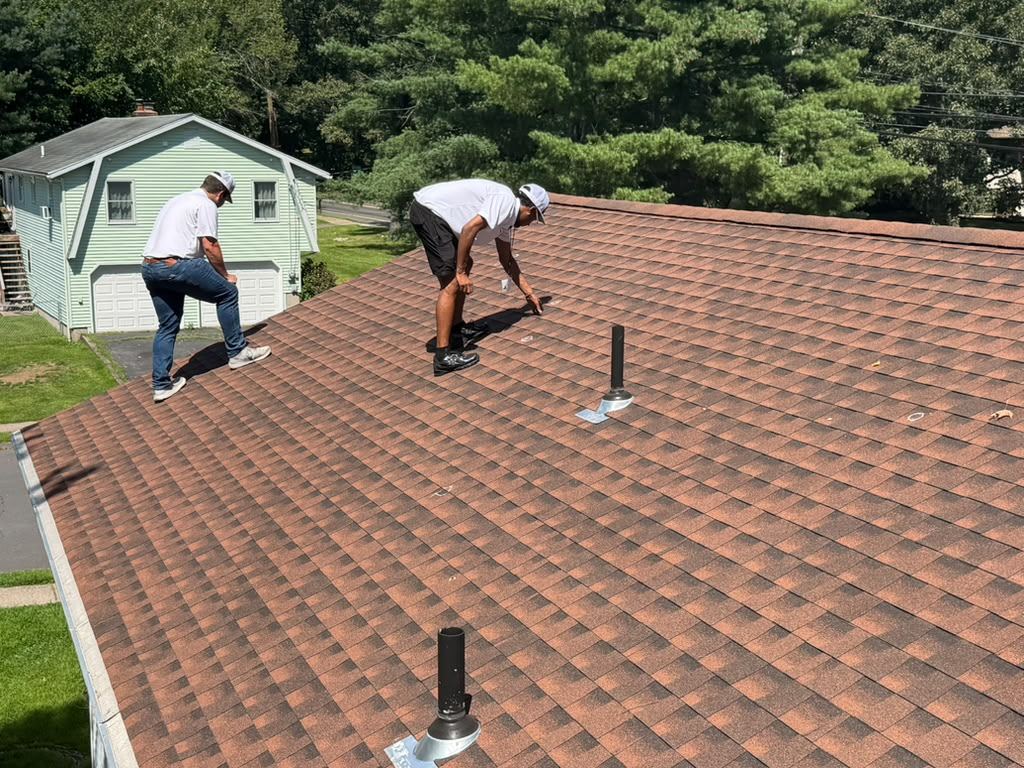
We inspect the roof, all four elevations, the soft metals, and the attic. We run test squares on each slope, photograph everything, and measure. Then we tell you plainly whether what we found looks storm-related and worth filing on — including when we think it is not.
You keep the photo report either way, whether you hire us or not.
3You + usSame day you decide
You file the claim
You call your carrier or agent, give them the date of loss, and write down your claim number and the adjuster's contact information. This call is yours to make — a contractor filing on your behalf is not something we do, and in several of the states we work in it is not something we may do.
What we do is aid in the filing process. We assist so that all questions the claims representative presents are answered and there is no lapse in communication between our company and your insurance company. That way we can coordinate a date to meet your adjuster at your property.
Where the line is
Deciding whether to file is your decision. We can tell you what we found on your roof; we cannot tell you what your policy covers. That is a question for your carrier or a licensed public adjuster.
4You + usTypically 3–14 days after filing
The adjuster comes out
You should be there. With your permission we meet the adjuster on the roof, walk them through what we documented, and hand over our line-item estimate and photos. Adjusters cover a lot of ground after a storm, and a second set of eyes that already knows where the damage is tends to make the inspection more complete.
Where the line is
We are there to present what we found and answer technical questions. We are not there to negotiate or advocate on your behalf — we are not licensed public adjusters, and negotiating your claim is not something we do in any market we work in.
5CarrierStatutory deadlines vary by state
The decision and the first check
If the claim is approved you get the carrier's estimate and the first check — the ACV amount, which is the replacement cost minus depreciation minus your deductible. It is usually made out to you and your mortgage company together.
How long your carrier has, by state
Wisconsin. A claim not paid within 30 days of written notice is legally overdue and accrues 7.5% simple interest (Wis. Stat. § 628.46).
Connecticut. Insurers must settle with reasonable promptness under the Unfair Insurance Practices Act (Conn. Gen. Stat. § 38a-816(6)), and losses under the standard fire policy must be resolved within 30 days of proof of loss.
New York. Once an amount is agreed, the insurer must pay within five business days, and must accept or reject a claim within 15 business days of receiving proof of loss (11 NYCRR 216.6).
Confirm what applies to your own policy with your carrier.
6You1–4 weeks
Your lender endorses the check
If you have a mortgage, that first check goes to your lender's loss-draft department to be endorsed and released. This step surprises people and it is often the slowest part of the whole process. Start it the day the check arrives.
7Us1–4 weeks per round
Scope review and supplement
We compare the carrier's scope line by line against what the job actually takes and document anything missing — with photos, measurements, and the code citation where a code drives the requirement. One or two rounds is normal, not a sign anything has gone wrong.
8Us1–3 days of production
We build the roof
Most residential re-roofs are a one- or two-day build. Scheduling depends on material lead time and how backed up the market is after a big storm event.
9Us + you2–6 weeks
Final documentation and the second check
We send the final invoice matching the approved scope, completion photos, the closed permit, the registered warranty, and a lien waiver. You submit it, and the carrier releases the recoverable depreciation — the second check.
10YouAt completion
You pay your deductible
Your deductible is your responsibility under your insurance policy. While certain discounts, promotions, or other forms of assistance may be available, homeowners should be cautious of any contractor promising to pay, absorb, or eliminate 100% of the deductible. A reputable contractor should be transparent about pricing, insurance proceeds, and any discounts or credits being applied to your project.
How long this really takes
A clean claim with no mortgage escrow and no disputes usually runs four to ten weeks end to end. After a major storm — with carrier catastrophe teams, escrowed proceeds, and multiple supplement rounds — three to six months is realistic. Anyone promising you a fixed timeline has not met your carrier.
 Eversafe Roofing